
Dhaka and Beijing on Thursday agreed to strengthen cooperation on the management of the Teesta and other rivers and signed 13 agreements to bolster bilateral ties following talks between Bangladeshi Prime Minister Tarique Rahman and Chinese Premier Li Qiang.

For India, the guiding principle should remain clear: Engage Bangladesh as a sovereign nation and society rather than through the prism of any individual leader or political party, suggests Manoj Mohanka.

Over Rs 180 crore was incurred on Prime Minister Narendra Modi's visit to 23 countries including the US, the UK, France, China and Japan in 2025, according to data shared by the government.
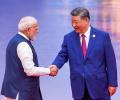
For India, China's Indian Ocean power projection, maritime domain awareness, dual-use ports, underwater surveillance, antisubmarinewarfare, naval exercises with Pakistan, pose considerable pressure, depleted India's strategic depth and marginalises Indian role, points out Srikanth Kondapalli.

Sensitive issues remain. Water sharing of the Ganga and Teesta rivers. Treatment of minorities, particularly Hindus. Border management. Trade imbalances. Connectivity projects.What happens next will shape not just bilateral ties, but the balance of South Asia itself, points out Ramesh Menon.
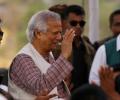
It was a meeting at the official level, not at the political level, Hossain said, adding that there was no element of formation of any alliance.

'The people of Bangladesh have voted for a party that represents political interest.'
'It is a pro-Liberation party and it believes in the spirit of 1971, as opposed to the Jamaat-e-Islami, which was opposed to the Liberation struggle of Bangladesh in 1971.'

Vikram Doraiswami, a seasoned diplomat, has been appointed as India's new ambassador to China, succeeding Pradeep Kumar Rawat. This decision comes as both countries attempt to improve bilateral relations following a period of strain.

In its annual report to Congress on Tuesday on 'Military and Security Developments Involving the People's Republic of China 2025', the US Department of War said the People's Liberation Army (PLA) is actively considering and planning for additional military facilities.

'China continues to perceive its relations with India through the prism of India-US relations, with the US using India to counter balance against China in the Indo-Pacific and beyond.'

China and Pakistan concluded their strategic dialogue, reiterating their opposition to unilateral actions in South Asia and discussing Kashmir, Afghanistan, and trilateral cooperation.

Bangladesh has expressed a potential interest in procuring JF-17 Thunder fighter aircraft from Pakistan, according to a statement from the Pakistan military. The development came during a meeting between the air chiefs of both countries, focusing on strengthening operational cooperation and institutional synergy.

Indian security agencies have continued efforts to reinforce the Siliguri Corridor through improved infrastructure, faster mobilisation capability and diversified connectivity routes to the north east.

The United States' historical strategic alignment with Pakistan, dating back to the Cold War, has consistently aimed to create a political and military parity with India, despite India's significantly larger size and resources. This long-standing relationship continues to influence regional dynamics, particularly in West Asia and the Indo-Pacific.

India may adopt a "calibrated" and a "step-by-step" approach to easing norms on investments originating from China, Union Commerce and Industry Minister Piyush Goyal said on Tuesday. He was in a conversation with A K Bhattacharya on Day 1 of Business Standard's two-day annual event, Manthan 2026. The minister said foreign direct investment (FDI) from China was certainly not "banned", but it goes through an approval process. "The government's approach at the moment is to accelerate the approval process."

Following the BNP's victory in recent elections, Bangladesh is seeking to reset its relationship with India, emphasizing mutual benefit and a recognition of the changed political landscape.

Four major political takeaways from Narendra Modi's much-anticipated trip to China

The UN Security Council will vote on a Bahrain-proposed resolution regarding the Strait of Hormuz, aiming to ensure freedom of navigation amid concerns and opposition from some members.

'Pakistan will also try to turn Bangladesh into a base for terrorist attacks on India.'
BNP chairman Tarique Rahman called for maintaining law and order and sought cooperation in building a safe and humane Bangladesh after his party's victory in parliamentary elections.

China has made serious inroads into Latin America, which the US may now be hinting is simply not ok: Stay in your lane, Xi! In simple terms, China will no longer have access to Venezuelan oil, points out Rajeev Srinivasan.

The UN Security Council, with India's support, has adopted a resolution condemning Iran's attacks on Gulf Cooperation Council countries and Jordan, demanding an immediate cessation of hostilities and denouncing threats to the Strait of Hormuz.
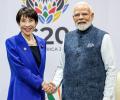
If they act now, they can reshape the strategic map of Asia without firing a shot. If they wait, the next opportunity will come only after a serious Taiwan Strait incident -- by which time the price will be far higher, and the room for boldness far smaller -- the opportunity may well be lost by then. The question is no longer whether this can or should be done, points out Varun Arya.

For decades, the Siliguri Corridor was treated as a geographical vulnerability to be quietly managed. Today, it has emerged as a focal point of eastern geopolitics.
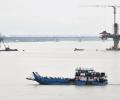
India has expressed concerns over China's plan to build a mega dam on the Brahmaputra River in Tibet, stating that it will continue to monitor and take necessary measures to protect its interests. New Delhi has urged Beijing to ensure that the interests of downstream states are not harmed by activities in upstream areas. The dam, estimated to cost USD 137 billion, has raised apprehensions about its impact on the ecological balance of Arunachal Pradesh and Assam, through which the Brahmaputra flows. India has repeatedly expressed its concerns to China through diplomatic channels, highlighting the need for transparency and consultation with downstream countries.
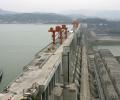
China defends its construction of a dam on the Brahmaputra river in Tibet, addressing concerns from India and Bangladesh about its potential impact on water flow and the environment.

India and the US have agreed to a trade deal that will see Washington reduce reciprocal tariffs on Indian goods from 25% to 18%, according to US President Donald Trump. The deal also includes commitments from India to reduce tariffs and non-tariff barriers against the US and to increase purchases of American products.

According to sources, India would be invited to the new proposed forum, while countries like Sri Lanka, Maldives, and Afghanistan are expected to be part of the grouping.

'However, we must implement a tit-for-tat approach -- reciprocating their conduct with precision.' 'If they demonstrate respect, we respond accordingly. If they adopt hostile positions, we mirror that hostility with equal intensity.'

The 2025 US National Security Strategy marks a major pullback, with America turning backward and effectively allowing China greater dominance in Asia. while long-time partners like India are left to face an increasingly unstable global order largely on their own, observes Rajeev Srinivasan.

China is set to build a rail link connecting Xinjiang province with Tibet, part of which will run near the Line of Actual Control (LAC) with India.

On President Putin's two-day trip to India, Jaishankar said for a "big" and "rising" country like India, it is important to maintain good cooperation with as many important players as possible in the world in line with freedom of choice.

'A less tense US-China relationship would make Beijing less likely to provoke India -- including on the border -- in retaliation for its close defence ties with the US.'

'The real story of 2025 is that India officially stopped being a 'market of the future' and started acting as the world's primary economic engine.'
China has defended its plan to build the world's largest dam on the Brahmaputra River in Tibet, assuring that the project will not affect riparian states and safety issues have been addressed through decades of studies. The dam, estimated to cost USD 137 billion, has raised concerns in India and Bangladesh, but Chinese authorities maintain that the project has been thoroughly studied and safeguards are in place. The dam is part of China's efforts to develop clean energy and respond to climate change.

China has reiterated its plan to build the world's largest dam over the Brahmaputra River in Tibet, near the Indian border. The Chinese Foreign Ministry has assured that the project, estimated to cost around USD 137 billion, will not have any negative impact on downstream countries, India and Bangladesh. The ministry has stated that the project has undergone rigorous scientific verification and will be conducive to disaster prevention and mitigation, as well as climate change response. India has expressed concerns about the dam, raising the issue during talks with the visiting US National Security Advisor, Jake Sullivan. China has maintained that the project will not negatively affect the lower reaches and has committed to maintaining communication with downstream countries.
China has approved the construction of the world's largest dam on the Brahmaputra River in Tibet, close to the Indian border. The USD 137 billion project, which is expected to dwarf even China's own Three Gorges Dam, has raised concerns in India and Bangladesh, the downstream riparian states. Concerns in India are centered around China's potential to control water flow, potentially enabling the release of large amounts of water to flood border areas in times of hostilities. The dam is part of China's 14th Five-Year Plan, and the Chinese government claims that the project is safe and prioritizes ecological protection.

Pakistan has reiterated its desire for normal neighbourly relations with India, while also criticizing India's decision to put the Indus Waters Treaty in abeyance. The Foreign Office spokesperson emphasized Pakistan's commitment to diplomacy and regional cooperation.

'If there is a military standoff eyeball to eyeball on the western border, the Chinese could create problems by making movements in the north, in our northeast, which could involve us tying down some forces there so that could stretch our military actions.'

We can expect to see more Chinese wolf warrior diplomats on the prowl, in India's neighbourhood, though its mailed fist is not so visible while dealing with India, observes Colonel R Hariharan (retd).
